
Big Brothers Big Sisters successfully working with NFL to recruit needed male mentors
By Grace Van Duyn
Nonprofit Sector News
July 1, 2026
Despite partnering with the NFL and introducing new sports-based mentoring programs, Big Brothers Big Sisters continues to face one of its greatest challenges: recruiting enough men to mentor boys who are waiting for positive role models.
Across the organization, boys consistently outnumber available male adult volunteers, leaving many waiting to be matched with a mentor. To address that imbalance, Big Brothers Big Sisters has increasingly turned to sports, hoping to reach audiences that traditional volunteer recruitment efforts have struggled to engage.
At a time when Americans are saying that they feel increasingly isolated and disconnected, Big Brothers Big Sisters faces a paradox: boys are seeking male mentors, yet too few men are stepping forward to fill the role.
The youth mentoring program, which pairs adult volunteers with children in need of positive role models, has long struggled to recruit enough male mentors. The shortage is particularly significant, as most of the children referred to the program are boys.
“70% of the people that are referred to Big Brothers Big Sisters of Eastern Mass. are boys, and only 40% of the volunteers that sign up for the program are men, so you know there’s a massive gap,” said Terrence McCarron, chief program officer of Big Brothers Big Sisters of Eastern Massachusetts.
Attempting to increase male participation in the organization, Big Brothers Big Sisters has established various male-centered campaigns and partnerships, including Mentoring Brothers in Action. This partnership between Big Brothers Big Sisters and the nation’s three largest African American fraternity chapters was established to engage more young African American men, who were already involved in faith-based and social organizations, in one-to-one mentoring.
Big Brothers Big Sisters, outside of fraternities, has sought out other organizational partnerships that emphasize these same social importance of community for men. One of those being the NFL.
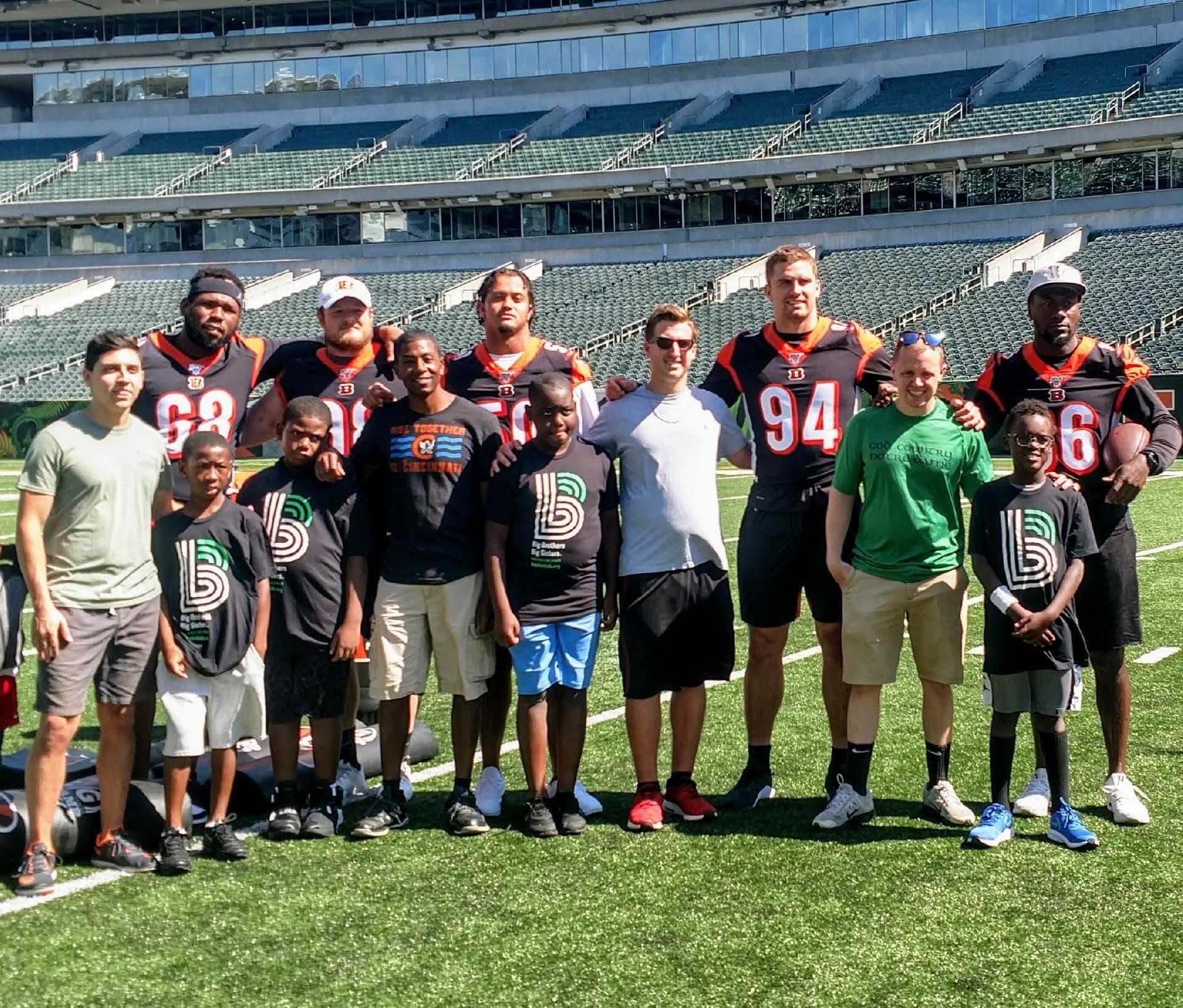
Since 2019, the organization has partnered with the NFL through The Big Draft, an annual recruitment campaign that coincides with the NFL Draft and encourages football fans to become mentors for children in their communities. With a particular focus on recruiting men and men of color, the campaign aims to address the organization’s longstanding shortage of male volunteers. This year, The Big Draft surpassed its goal of recruiting 10,000 volunteers in 60 days, bringing more than 14,000 new volunteers into the program nationwide.
Throughout the campaign, local chapters host football-themed recruitment events where prospective volunteers can learn about mentoring, hear from bigs—Big Brothers Big Sisters’ name for mentors—and begin the enrollment process before welcoming a new “rookie class” of bigs during NFL Draft celebrations.
For local chapters, the partnership has also helped expand community awareness.
“Being able to partner with the Steelers and be a community partner really elevates the relationship, not just on a national level but on a local level,” said Maggie Giel-Bovaird, chief advancement officer of Big Brothers Big Sisters of Greater Pittsburgh. “The press comes out anytime the Steelers are there.”
While The Big Draft is a national campaign, local chapters have flexibility to create programs that reflect the needs of the communities that they serve.
“Every chapter in the Big Brothers Big Sisters network has different programs that meet the needs of their community,” Giel-Bovaird said. “If that’s more rural, more suburban, more urban, whatever the needs are of the community, we have programs that can fit that.”
One example is Greater Pittsburgh’s Sports Buddies program, which pairs bigs and littles through organized athletic activities such as sports clinics, open-play sessions and professional sporting events. Rather than simply asking men to mentor, Sports Buddies removes barriers that can discourage participation by giving mentors structured activities and making the experience feel less overwhelming.
“We have a Sports Buddies program...it was a way to get little brothers off the waiting list,” Giel-Bovaird said. “Our studies were showing that if we had enough activities for the match to do, the Big Brother felt mentoring was easier. ‘Hey, show up to the park and we’ll play baseball.’ Not having to come up with the activity, males seemed to raise their hand more quickly on that.”
Still, even with national recruitment campaigns, NFL partnerships and sports-based programming, the organization's shortage of male mentors remains.
According to Erin Pash, a Minneapolis-based therapist and founder of Ellie Mental Health and PASH CO., the issue is not necessarily that men are unwilling to help.
“It's like they like it in theory—‘Yep, I love giving back, I love helping’—but then there is a pretty intense emotional ‘Whoa, what is this going to take for me?’” Pash said.
More than a century after Big Brothers Big Sisters founding, this pre-mentorship hesitation has become particularly concerning, as recent familial trends are leaving boys without role models.
Over the past several decades, the share of American children living in single-parent households has more than doubled, driven largely by increases in female-headed households. As a result, many boys currently entering the program are growing up without a consistent male role model at home.
McCarron believes that mentorship within Big Brothers Big Sisters can help fill that gap but only if men are willing to take the first step.
“We know that men are less likely to sign up to be mentors, and that men are less likely to finish the process once you start to become a mentor,” he said. “But once matched with a mentee, they’re more likely to keep going.”
The irony, according to McCarron and Pash, is that the men who are hesitant to volunteer may be among those who stand to benefit the most.
As McCarron put it, “maybe oftentimes we don’t know what we really want and need in our lives.”
For those considering volunteering, Giel-Bovaird said that the expectations are often much simpler than people imagine.
“People don't need to be perfect. They don't need to be the Disney volunteer. They need to be present and consistent and say they’re going to show up. This is not about spending millions of dollars. It’s about spending your time and having an impact on a child's life.”